
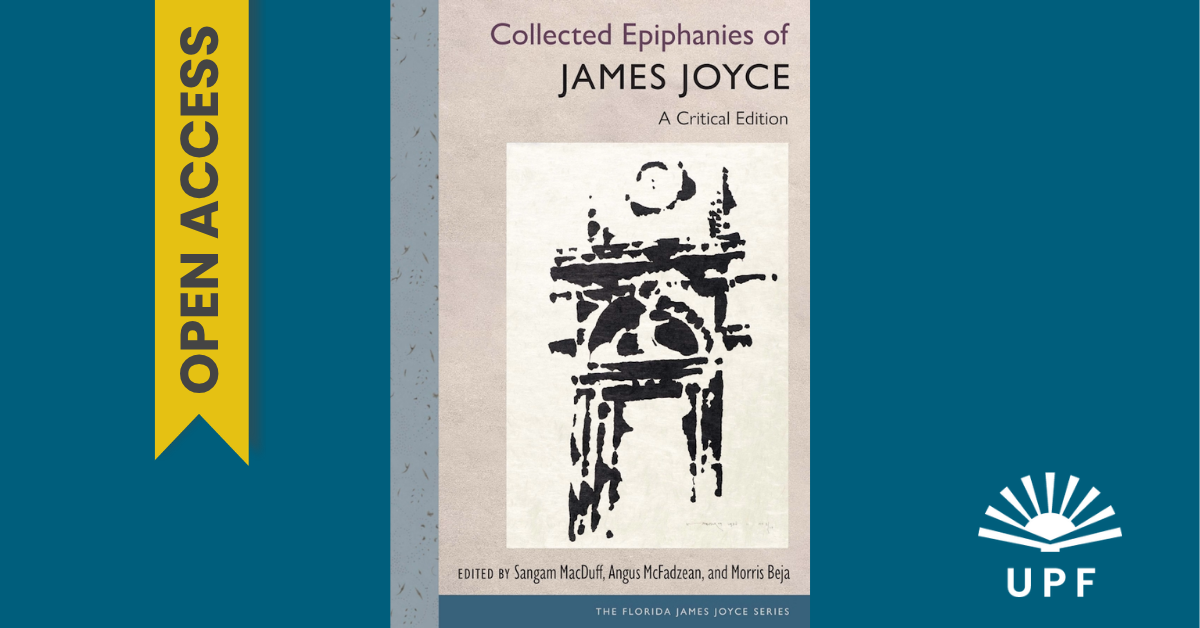

Collected Epiphanies of James Joyce: A Critical Edition offers the first critical edition of the forty short texts James Joyce called “epiphanies.” Among Joyce’s earliest literary compositions, although published posthumously, the epiphanies are a series of highly polished miniatures, many of which Joyce reused in his later writings. By presenting the epiphanies with background details and thorough annotations, this edition provides a vivid insight into his art.
Here, coeditor Sangam MacDuff discusses his OA experience with Collected Epiphanies of James Joyce.
How long after initial publication was your book made available Open Access (OA)?
Immediately. The OA edition was published at the same time as the cloth and paperback versions.
What funding opportunity allowed your book to be made OA?
An OA publication grant from the Swiss National Science Foundation.
Why were you interested in publishing your book OA?
Because it is the policy of the Swiss National Science Foundation that all the research they fund should be published in OA (the research for our book was also funded by the SNSF).
What is the value of OA for your discipline and for scholarship more broadly?
It makes research more widely accessible.
Have you had any feedback about the OA edition of your book?
I heard from Morris Beja (our late co-editor) that he had heard from several of his friends to say how much they appreciated the book. I also heard that my former supervisor, Finn Fordham, had tweeted the link to his many followers, resulting in a lot of interest in the book on social media and a number of reviews in the UK, Ireland, Japan and India (I have seen 10 reviews to date, most of which were very positive).
The open access edition of Collected Epiphanies of James Joyce was published with the support of the Swiss National Science Foundation. Read for free at University of Florida Digital Collections.
Sangam MacDuff is research fellow at the University of Lausanne. His book Panepiphanal World: James Joyce’s Epiphanies is also available freely available in an open access edition, published with the support of the Swiss National Science Foundation.